Introduction
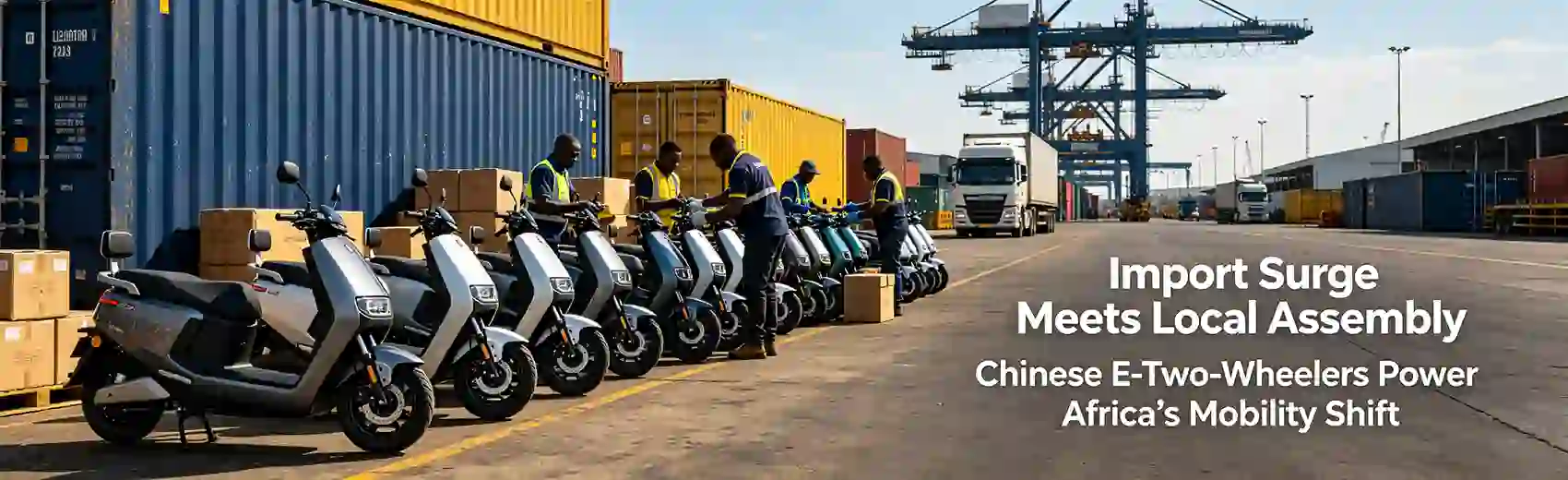
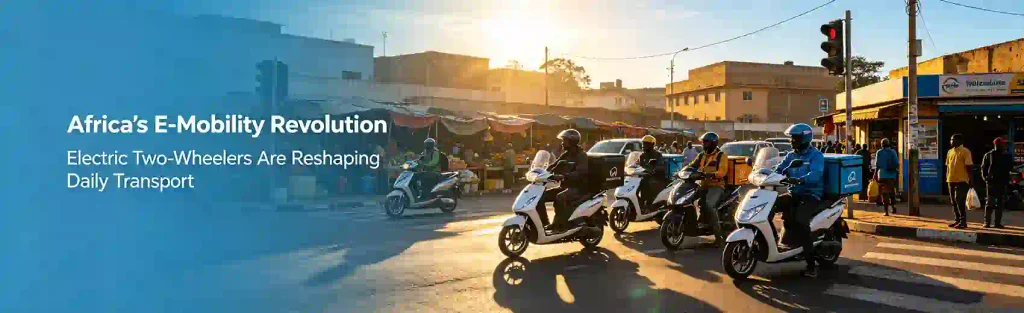
Across city streets, rural highways and bustling market towns of Africa, a quiet transport revolution is gathering speed. Once dominated by noisy gasoline‑powered motorcycles used for taxi services, parcel delivery and daily commuting, African mobility markets are rapidly shifting toward electric two‑wheelers. Customs trade statistics for the first half of 2026 show that African imports of electric motorcycles and tricycles from China have surged 60% year‑on‑year, reaching a total value of $114.6 million. This explosive import growth is not driven by environmental advocacy alone. It is fundamentally powered by hard economic reality for millions of commercial riders, shifting government energy priorities and mature cross‑border supply chains originating in China.
Many global observers focus on passenger electric cars when discussing Africa’s energy transition. However, four‑wheel passenger vehicles remain unaffordable for most populations. Two‑wheel and three‑wheel vehicles represent the backbone of daily movement across most African nations. An estimated 8 million two‑wheel units sell across Africa annually, the vast majority for commercial passenger‑hauling and last‑mile logistics work. For millions of “boda‑boda” motorcycle taxi drivers and delivery couriers, motorcycles are not leisure toys, but core income‑generating business assets. The accelerating arrival of imported electric motorcycles therefore carries far‑reaching social, commercial and industrial consequences for the whole continent.
The Market Numbers: Where Import Growth Is Concentrated
Import data reveals two very distinct development paths emerging across African regions.
North Africa leads total import volumes of fully‑built‑unit electric scooters and mopeds. Morocco ranks as the top single importer in H1‑2026, bringing in 80,188 units worth $21.7 million, followed closely by Egypt and Algeria. In these markets, imported complete electric two‑wheelers mostly serve private urban commuters. Relatively stable power grid infrastructure supports home and public charging, and consumers seek low‑cost alternatives to high gasoline prices.
Sub‑Saharan Africa follows a different blueprint. South Africa records the highest import volume here, with 19,635 imported light electric two‑wheelers valued at $6.9 million in the same period. East African markets including Kenya, Rwanda and Uganda do not import massive volumes of fully‑assembled finished bikes. Instead, local startups import Chinese‑sourced kits, lithium‑ion batteries and core components to run domestic CKD (Completely Knocked‑Down) assembly plants. Kenya’s market demonstrates remarkable penetration: electric motorcycles captured 15.3% of all new motorcycle registrations in 2025, climbing from a mere 0.5% back in 2021.
Total African e‑motorcycle sales jumped from approximately 9,000 units in 2024 to roughly 95,000 units in 2025. Industry forecasts expect sales to hit between 180,000‑220,000 units for full‑year 2026. Crucially, this growth happens with minimal government purchase subsidies. Riders make switching decisions primarily based on monthly operating‑cost savings, not green policy incentives.
Why Commercial Riders Choose Imported Electric Motorcycles
For boda‑boda taxi and delivery riders working 8‑12 hours each day, running 100‑150 kilometers daily, gasoline expense eats a huge share of daily revenue. When regional fuel prices spike, driver take‑home income collapses quickly. Electric motorcycles reverse this financial pressure.
Field surveys in East Africa indicate professional electric motorcycle operators achieve 35‑45% higher net monthly income, compared to peers operating petrol bikes. Electricity cost per kilometer is a small fraction of gasoline expense. Electric motors also contain far fewer moving mechanical parts than combustion engines. Oil changes, valve adjustments and complex engine repairs largely disappear, cutting regular maintenance spending dramatically.
Battery‑swapping business models solve two major pain points simultaneously: range anxiety and long charging downtime. Instead of waiting hours while a bike charges, riders pull into swap stations and exchange depleted battery packs for fully‑charged units in less than two minutes. This operational model fits perfectly for commercial fleets that cannot afford long work interruptions. Multiple large‑scale swap‑network operators source huge volumes of lithium‑ion battery packs directly from Chinese manufacturers; one major pan‑African mobility startup plans to purchase around 350,000 Chinese‑manufactured batteries during 2026 aloneXinhua Sil….
It should be noted that battery swapping also partially mitigates unstable local power‑grid conditions. Many swap hubs deploy backup solar generation, working around frequent national‑grid blackouts widespread across many sub‑Saharan territories.
Divergent Regional Strategies: Finished‑Unit Imports vs Local CKD Assembly
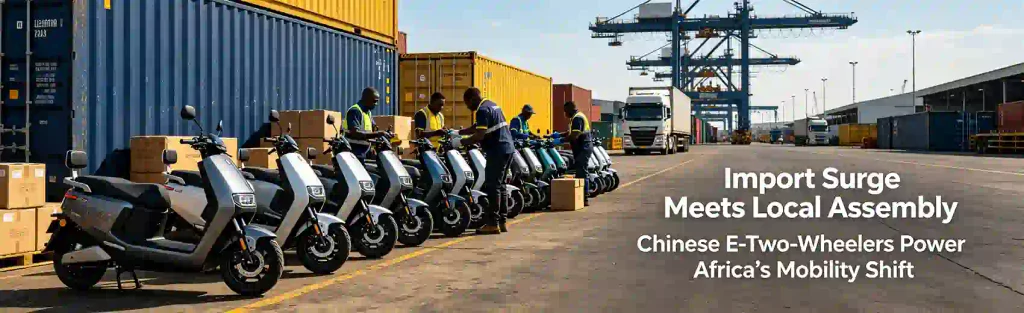
Buying fully‑built complete scooters imported from China remains the dominant model across North Africa. Businesses and consumers receive ready‑to‑ride vehicles with minimal local manufacturing involvement.
Conversely, East, Central and West African markets increasingly favor CKD/SKD component import plus domestic local assembly. Local assembly creates domestic factory jobs, reduces final import‑duty burdens, enables faster spare‑parts response and supports custom modifications for local road conditions. Chinese suppliers adapt by shipping disassembled vehicle kits, BMS battery management systems, motor assemblies and accessory components rather than only finished motorcyclesChina Dail….
Nigeria represents the largest‑volume two‑wheeler market on the continent with over 220 million residents. Large domestic fleet operators import core kits and assemble e‑motorcycles inside Lagos and Kano factories, serving both domestic demand and neighboring‑country re‑export opportunities. This shift shows that trade between China and Africa for electric mobility is evolving beyond simple finished‑goods export, moving toward deeper supply‑chain cooperation.
Key Barriers That Slow Down Full‑Scale Adoption
Despite impressive import growth numbers, substantial obstacles remain before electric two‑wheelers dominate African roads.
First, high upfront purchase price stays the biggest barrier. Even with lower day‑to‑day operating expenses, brand‑new electric motorcycles carry higher sticker prices than second‑hand gasoline motorbikes widely available locally. Most working‑class commercial riders cannot afford lump‑sum purchases. Creative financing solutions including mobile‑money‑supported installment plans, asset‑backed lending and “ride‑to‑own” subscription schemes become essential to unlock mass‑market adoptionRMI.
Second, power‑grid unreliability creates persistent risk. Many territories suffer frequent scheduled and unscheduled power cuts. Some battery‑swap stations resort to fossil‑fuel generators as backup power supply, eroding part of the environmental benefits of electric mobility transition. Solar‑powered swap stations offer a viable workaround but demand extra capital investment.
Third, fragmented technical standards complicate ecosystem scaling. Today, most battery‑swap hardware is proprietary and brand‑locked. A battery pack from one operator cannot fit into a competitor’s motorcycle chassis. Rwanda has already introduced regulatory rules mandating interoperable swap hardware, but most other African nations still lack unified standards for batteries, vehicle safety and import compliance. Currency volatility and US‑dollar‑denominated equipment import costs also create financial pressure for local operators earning income in local soft currencies.
Fourth, after‑sales service networks and spare‑part coverage remain patchy in many remote zones. Imported electric motorcycles require trained technicians familiar with motor controllers, BMS systems and lithium‑ion battery safety protocols. Skill gaps can limit long‑term user satisfaction.
Outlook & Opportunities for Global Suppliers
Market projections suggest electric two‑wheelers may capture more than half of total African motorcycle sales by 2040, supported by continuously falling lithium‑ion battery costs and expanding swap‑station footprints. For Chinese manufacturers and international trading companies, African markets demand more than just shipping standard‑spec e‑scooters built for domestic Asian or European roads. Winning product portfolios must feature reinforced frames for rough unpaved roads, robust dust‑resistant electrical components, and compatibility with battery‑swap architectures.
Different territories call for distinct commercial strategies. North African markets favor high volumes of completely‑built finished scooters. East and West Africa reward CKD kit exports, technical training partnerships and collaboration with local fleet operators. Cross‑border traders must also study local import tariff rules, certification requirements and financing landscapes country‑by‑country, rather than applying one uniform sales strategy for the whole continent.
Africa holds massive reserves of battery‑critical minerals including cobalt, manganese and graphite. In the long‑term future, the continent could advance from being a large‑scale importer of finished electric mobility hardware toward developing its own local battery‑cell manufacturing capacity. Right now, however, surging import volumes clearly signal that Chinese‑origin electric motorcycles form the cornerstone for Africa’s two‑wheeler electrification wave.
Conclusion
The sharp 60% jump in African e‑motorcycle imports from China during H1‑2026 is far more than temporary trade statistics. It marks a structural shift for continental mobility. Driven overwhelmingly by commercial riders chasing tangible cost savings rather than climate policy, electric two‑wheelers are rewriting daily transport economics across dozens of African cities.
Major hurdles including financing gaps, grid instability and fragmented technical standards still stand in the path. Even so, market momentum appears irreversible. Companies that understand regional differences between finished‑unit import markets and CKD‑assembly‑foused territories, and tailor hardware and business models accordingly, will capture the biggest share of this fast‑growing frontier market in the coming five‑to‑ten‑year period.